Our approach
What your child actually does here on a Tuesday morning.
Four steps run in every subject, every week: children explore a new idea, reflect on what they noticed, extend it further, then apply it to something real.
The same four steps run in Playschool, Preschool and Student Care.
A free discovery visit.
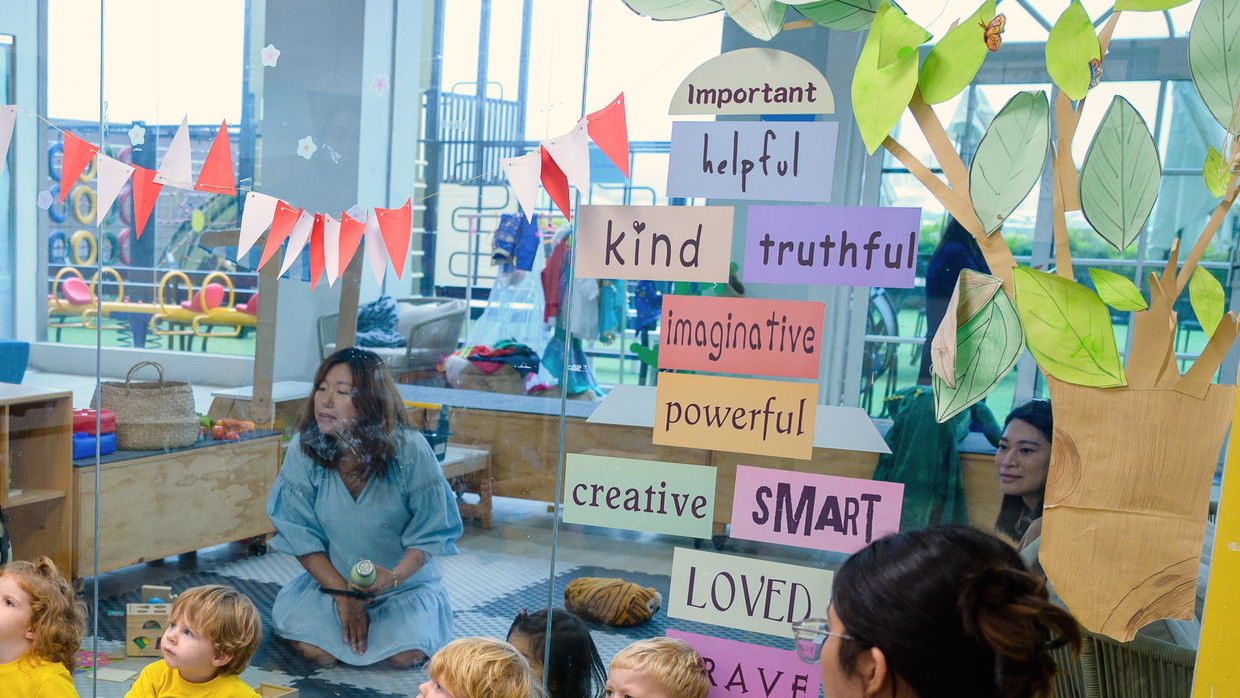
The cycle
Four steps, in every subject, every week.
- Explore
A new idea, and room to test it
Each concept starts with just enough instruction to point the way, never a full explanation. Children explore it in small, deliberately mixed groups, so every child meets the idea somewhere they can actually get a grip on it.
- Reflect
They check in on their own thinking
Working with a partner or on their own, children look back at what they just tried and say what they noticed. Self and peer assessment, in their own words, and often the first moment they realise what they do and don't yet understand.
- Extend
Then they try it again, differently
Second time round, some children push further into the idea; others get more scaffolding to secure it. Either way they reflect a second time, because understanding your own learning matters as much as doing the activity.
- Apply
Finally, they put it to use
The day closes with children applying what they've learned to something real, and a teacher assessment that completes the loop. That evidence carries straight into what comes next.
Why it starts here
Thinking begins with feeling safe.
Care is the foundation of the learning here. A child who is anxious about being left, or about getting something wrong, has no attention left over for a hard question.
So your child gets as long as they need to feel comfortable in the room before anyone asks them to work in it. Some settle in a morning, some take a term, and both are normal.
How we know where a child is
Your child's Individual Learning Plan is reviewed every six weeks.
Every child in Preschool has an Individual Learning Plan covering six areas of development. It's built from written observations of what your child actually did, in their teacher's own words.
Each time, their teacher reviews the plan and updates it from what they've seen. What we expect of your child moves with what they're ready for, not with their birthday.
The question we get asked most
“Isn’t Agora a bit unstructured?”
It's a fair question. Unstructured would mean no plan; what we run is structure without heavy control. Here's the difference:
Order held by the adults
Build the order into the room
- Clear rules, close supervision, a reward for compliance and a cost for stepping out of line.
- It works. It works quickly, and it looks impressive on a school tour.
You get a child who is well behaved in front of authority.
The way we chose
Build the order into the child
- Enough freedom, early enough, that a child has to develop their own judgement about what is safe, what is fair and what is expected.
- They carry that judgement out of the room with them.
- It is slower, it is less visible, and on any given afternoon it looks less tidy.
You get a child who is well behaved whether or not anyone is checking.
Structure here is a routine your child can predict: the same four steps, the same adults, the same order to the morning. It asks more of us, and a little more patience of you. Come on an ordinary morning and watch one.
Before you choose
Four things parents ask us about.
Your child is measured against your child
Progress is recorded against what your child could do last term, and that is the only comparison we make.
Your child works at their own level
Children start from the level they're at, and the week is built around what they can already do.
One teacher to six children
That is the ratio in every Preschool class.
What the fee covers
The Preschool and Student Care pages list what is included and what sits outside the fee. We go through the current fee with you at your visit.